The Swimming Time Log Book: A Practical Companion for Every Swimmer Who Wants to Improve
For anyone who regularly glides through the water, the feeling of a strong, efficient stroke is deeply rewarding. Yet, progress can feel elusive without a way to capture the small victories, track the hard data, and learn from each session. This is exactly where a Swimming Time Log Book steps in. Far more than a simple notebook, it is a deliberate tool that helps you turn every lap into a meaningful step toward your personal goals. Whether you are a beginner finding your rhythm, a fitness enthusiast chasing better endurance, or a competitive athlete targeting a personal best, a structured swim log changes how you relate to your time in the pool.
Why Swimming Progress Can Feel Invisible
Adult swimmers often juggle busy schedules, squeezing sessions in before work or during lunch breaks. In the rush, vital feedback disappears. You might leave the pool thinking, “That felt fast,” but next week you cannot recall your exact pace from a month ago. A Swimming Time Log Book gives those memories a permanent home. It transforms subjective feelings into objective history you can review, refine, and celebrate.
How a Focused Swim Journal Transforms Your Training
A Swimming Time Log Book also strengthens accountability. On a day when motivation dips, seeing a chain of filled pages encourages you to keep the streak alive. It becomes a trusted training partner, one that patiently receives your notes without judgment and returns them as clear, actionable guidance.
Recording What Actually Matters
- Date, time, and pool type – length, indoor or outdoor.
- Total distance and duration – the big-picture volume.
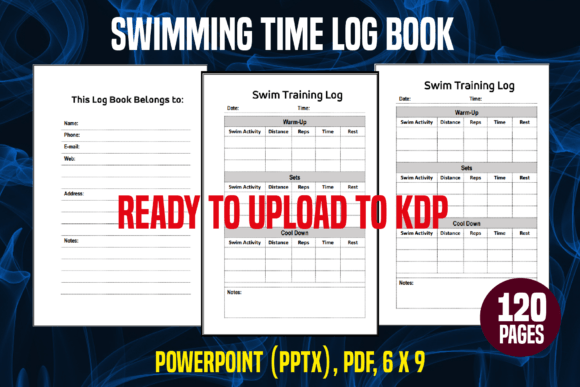
- Main set details – repeats, target times, actual times, rest intervals.
- Stroke specifications – freestyle, backstroke, drills, kicking sets.
- Perceived effort and physical notes – rate your exertion from 1 to 10, note any tightness or fatigue.
- Technique focus – the one cue you worked on, such as high elbow catch or bilateral breathing.
Setting Goals You Can Actually Reach
A goal without a plan is just a wish. Using a Swimming Time Log Book, you can break ambitious targets into weekly, manageable steps. For example, if your aim is to complete a 1.5-kilometer open water event comfortably, you start by noting your current comfortable distance and pace. Then, each week, you log slightly longer continuous swims and track your average pace per 100 meters. The log becomes a progress bar: week one you fade at 800 meters, but by week eight you comfortably hit 1,400 meters with energy to spare. That visual evidence builds confidence that no mental pep talk can replicate.
Real-World Applications for Every Swimmer
For the beginning adult learner, the journal is a confidence builder. Early entries might focus on simple counts—how many laps without stopping, how many breaths to each side. A few months later, reading back through those beginner notes shows dramatic, tangible growth that fuels the desire to keep learning.
For the fitness swimmer, the log tracks consistency and helps prevent the dreaded plateau. You can cycle through different energy systems by planning aerobic endurance days and higher-intensity interval sets, then logging how your body responded. This prevents the routine from becoming stale and ensures you are always moving toward your health goals.
For the competitive masters swimmer, precision is everything. A dedicated Swimming Time Log Book captures exact splits, rest ratios, and competition results. Over a season, this data makes tapering decisions easier. You can look back and see which training phase produced your fastest times and recreate that approach for your next peak event.
For triathletes, the swim log integrates with a broader training plan. Open water practice days can be noted with conditions, navigation notes, and wetsuit feel. Pool sessions bridge the gap, and the log helps the athlete see improvement in sighting efficiency or stroke rate over time.
For those rehabilitating from injury, a swim log provides gentle accountability and a safe way to track incremental increases in load. A doctor or physiotherapist may set limits, and logging every session ensures you respect those boundaries while still seeing progress in reduced pain or improved range of motion.
Practical Ways to Make the Log Book a Consistent Habit
- Keep your Swimming Time Log Book directly in your swim bag, next to your goggles. When you pack up, you see it and fill it in immediately.
- Use a shorthand that works for you. Abbreviations like “WU” for warm-up, “MS” for main set, “CD” for cool-down save time.
- Set a weekly reminder on your phone for Sunday evening to review the past week’s entries and set intentions for the coming sessions.
- Do not chase perfection. A messy, half-filled page with key numbers is far more valuable than a blank page left for tomorrow.
Selecting a Format That Supports Your Journey
A printable or pre-printed Swimming Time Log Book offers distinct advantages. The tactile experience of writing by hand improves retention of the details. You avoid screen glare and the temptation to quickly check messages. A well-designed interior, with clearly labeled sections and enough space for notes, removes the friction of drawing your own tables.
Overcoming the Common Fears Around Log Keeping
Some adults worry that meticulous logging makes swimming feel like work. In reality, the opposite is true. A Swimming Time Log Book frees you from trying to remember everything, so you can be more present in the water. You swim the set, then trust the pages to hold the data until you are ready to analyze it later. Another concern is honesty—it can be uncomfortable to write down a disappointing session. But those slower days hold the most valuable lessons about recovery, nutrition, or stress. By welcoming those entries, you build resilience and a realistic picture of your athletic life.
The Swimming Time Log Book as a Lifetime Record
Getting Started Today
You do not need to wait for a new month, a new year, or a perfect plan. Your next swim can be the first entry. Grab a dedicated notebook or a professionally designed Swimming Time Log Book, and jot down the basics after your cool-down. Include the date, total time, main set details, and a single sentence about how you felt. That one act plants the seed. With each session, you layer on more data, more awareness, more growth.
Swimmers who commit to logging almost universally report feeling more connected to their sport and more in control of their improvement. They stop guessing and start knowing. They turn aimless laps into deliberate practice. Whether you train to beat the clock, to find a moving meditation, or to simply stay healthy, a Swimming Time Log Book elevates your experience from something you do to something you actively shape. The water is ready. Let your log guide the way.