The 3 Minute Gratitude Journal for Kids: A Simple Practice with Lasting Impact
In a world where children are navigating more stimuli, expectations, and digital noise than any generation before them, the idea of pausing for three minutes to reflect on something good might sound almost too simple to matter. Yet that simplicity is precisely what gives The 3 Minute Gratitude Journal for Kids its quiet power. It is not a workbook packed with overwhelming prompts or a curriculum demanding rigid lesson plans. It is a focused, repeatable space where a child can build the habit of noticing what went right—an act that research across positive psychology has repeatedly linked to improved emotional regulation, better sleep, and a more resilient outlook on everyday challenges.
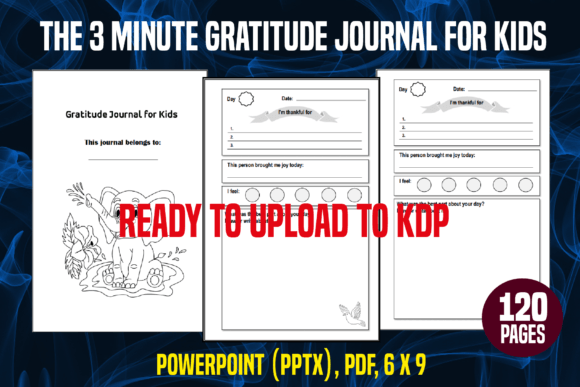
What sets this particular resource apart is that it arrives as a fully tested, production-ready package for anyone who wants to bring it to life in print. The included files—a downloadable ZIP containing an editable PowerPoint source file and a high-resolution PDF interior—have been validated through Kindle Direct Publishing. The trim size sits at a practical 6 x 9 inches, spanning 120 pages of thoughtfully laid-out interior content. This means the journal is not just a concept or a set of instructions; it is a tangible product that a parent can print at home, a teacher can reproduce for a classroom, or a small publisher can upload and offer through print-on-demand channels with minimal friction.
Why Gratitude Practices Are Gaining Ground in Children's Daily Lives
The conversation around children's mental and emotional health has shifted noticeably over the past decade. Schools are integrating social-emotional learning into core curricula. Pediatricians are asking about screen time not just as a vision concern but as a variable tied to anxiety and attention. Parents, many of whom are themselves burnt out on constant connectivity, are actively seeking grounded, analog practices that offer a counterbalance to the pace of modern childhood.
Gratitude journaling fits into this landscape with a rare combination of being research-supported and remarkably low-barrier. When a child writes down or draws something they are thankful for, they are not just recording a fact. They are practicing selective attention—learning to scan their day for moments of connection, small victories, or simple comforts. Over time, that scanning becomes less of a deliberate exercise and more of an automatic lens. The three-minute format respects a child's developmental capacity without turning reflection into a chore. It acknowledges that consistency matters more than duration, especially when building emotional habits that may carry forward into adolescence and adulthood.
What the Three-Minute Structure Actually Teaches
The time-bound nature of this journal is not arbitrary. A three-minute window is long enough to invite genuine reflection but short enough to sidestep the resistance that often accompanies longer writing tasks, particularly for children who may struggle with expressive language or fine motor skills. The journal does not ask for paragraphs; it asks for presence.
Within those three minutes, a child might name one person who made them smile, one thing they learned, or one moment they would like to remember. The prompts are designed to be broad enough to accommodate different ages and writing abilities while still guiding attention toward the specific. This approach mirrors what cognitive behavioral practitioners call "positive activity scheduling," where small, intentional actions gradually reshape internal patterns of thought. The difference is that the journal makes the process feel less clinical and more like a personal ritual—something a child can take ownership of from the very first page.
The Files Themselves: What Creators and Educators Actually Receive
For those who intend to publish, distribute, or adapt the journal, the delivered assets are designed for practical use from day one. The ZIP file contains two primary formats. First, the editable source file in PowerPoint (PPTX) gives full control over text, layout, and branding. Someone running a children's coaching practice could adjust prompts to align with a specific program. A school counselor could translate pages into a second language. A self-publisher could incorporate the journal into a larger series and maintain visual consistency across titles.
Second, the high-resolution PDF interior is formatted and ready for direct upload to KDP or for local printing. This file has already been tested for compatibility, which removes one of the most common friction points in print-on-demand publishing—the back-and-forth of formatting errors, margin adjustments, and bleed settings that can stall a project for days. The 120-page count hits a comfortable sweet spot: substantial enough to feel like a real book, lean enough to keep production costs manageable, and divisible neatly across weeks or months of daily use.
Trim Size and Why 6 x 9 Matters
The 6 x 9-inch trim size is one of the most widely supported formats in the print-on-demand ecosystem. It is compact enough for a child's hands and a backpack pocket, yet large enough to give each daily entry breathing room. From a production standpoint, this size also keeps printing costs predictable and opens the door to global distribution through Amazon's regional print facilities. The high-resolution interior ensures that any illustrations, borders, or decorative elements remain crisp whether the journal is printed on standard white paper or a slightly warmer cream stock for a more inviting feel.
Practical Ways Parents and Educators Are Weaving Gratitude into the Day
The flexibility of a printable, reproducible journal means it can slide into different rhythms without demanding a complete schedule overhaul. Some families keep a printed copy on the breakfast table, using the three minutes as a gentle transition from morning chaos to the school day ahead. Others integrate the journal into a bedtime wind-down routine, letting children reflect on the day's small joys before sleep—a practice that aligns with emerging research on gratitude's positive effect on sleep quality in both adults and youth.
In classroom settings, teachers have found that a short gratitude pause after lunch or during homeroom can shift the collective mood. One third-grade educator in the Midwest described using a similar journal format as a soft reset after recess, noting that even children who initially rolled their eyes began to ask for "the thank-you book" within two weeks. The key, she observed, was never forcing participation. Some children wrote sentences; others drew pictures. The journal accommodated that spectrum without making anyone feel behind.
For homeschooling families, the journal can double as a gentle handwriting practice and an emotional check-in, blending academic skill-building with personal development in a way that doesn't feel contrived. Because the source file is editable, families can customize it to include seasonal themes, family-specific prompts, or even a sibling-shared entry format.
The Low-Content Publishing Angle and Why It Resonates Now
The rise of low-content and medium-content publishing on platforms like KDP has opened doors for creators who might not consider themselves traditional authors. Journals, planners, and guided notebooks represent a segment where thoughtful design and genuine utility matter more than narrative prowess. For a marketer, a family blogger, or an educator with a small audience, offering a gratitude journal under their own brand can serve as both a revenue stream and a community-building tool.
The full editable source file changes the calculus for these creators. Instead of starting from a blank slide and navigating trim sizes, margins, and interior formatting from scratch, they begin with a tested template. Time that would have gone to layout can go to refining messaging, designing a cover, or creating supporting content that explains the journal's purpose to potential buyers. The 120-page count is also advantageous here: it reaches a psychological threshold where a printed product feels like a "real book" rather than a pamphlet, which can support healthier pricing and perceived value on a marketplace shelf.
Designing for Children Without Underestimating Them
A subtle but important principle running through well-designed gratitude journals for kids is the balance between playfulness and respect. Children can sense when a product is talking down to them. The best formats offer clean, uncluttered pages with enough structure to guide but not so much decoration that the purpose gets lost in the noise. A high-resolution interior becomes especially relevant here, because blurry line art or pixelated borders can unconsciously signal low quality and erode a child's willingness to engage seriously with the content.
The editable PowerPoint file gives designers and creators the ability to fine-tune this balance. Fonts can be swapped for readability. Line spacing can be adjusted for children who are still developing their handwriting or for those who prefer to type responses on a tablet. The journal, in this sense, becomes a starting point for iteration rather than a static product, which is one of the underappreciated advantages of purchasing editable source files over locked PDFs.
What This Means for the Broader Shift Toward Intentional Childhood Resources
Parents and educators today are not just buying products; they are making micro-investments in frameworks and habits. The mindfulness coloring book that seemed novel five years ago now shares shelf space with emotional literacy card decks, yoga-for-kids guides, and a growing library of gratitude-focused tools. This is not a fad so much as a collective recognition that emotional skills, like any other skills, benefit from regular practice and thoughtful scaffolding.
The 3 Minute Gratitude Journal for Kids enters this space not with loud promises but with a clear, tested, and adaptable structure. The fact that it comes as a KDP-ready package broadens its reach. A counselor in the UK, a parent in Toronto, and a small publishing brand in Melbourne can all take the same core files and tailor them to their communities. That scalability, paired with the journal's inherently personal nature, reflects where many helpful content products are heading: toward resources that are both universally relevant and locally adaptable.
For the professional looking to publish, the editable format slashes the timeline from concept to listing. For the parent or teacher, the ready PDF means printing a fresh copy for a new semester or a new child is a matter of minutes. In both cases, the value lies not in a single use but in the ability to reuse, adapt, and share the practice across different contexts and over time.