Easter Day Grid Drawing Worksheet for Primary Middle Grades
Few activities blend mathematical thinking and artistic expression as seamlessly as a grid drawing worksheet. The Easter Day Grid Drawing Worksheet for Primary Middle Grades takes that blend further by using a coordinate grid with letters on the x‑axis and numbers on the y‑axis — a gentle, accessible introduction to map skills and graphing that still produces a charming seasonal picture. Packed inside a ready‑to‑print ZIP file, the set includes everything needed to celebrate Easter through a focused, low‑prep project. Whether you’re an educator planning a thematic week, a parent hunting for a screen‑free holiday activity, or a hobbyist intrigued by the grid method used by Leonardo da Vinci and Albrecht Dürer, this unit fits remarkably well into a variety of routines and skill levels.
A Classroom Asset with Multiple Entry Points
For teachers, the Easter Day Grid Drawing Worksheet offers flexibility that a rigid curriculum script often can’t. You might use it as a whole‑class project during Easter week, tying it directly to a maths lesson on coordinate planes. Because the grid labels are letter‑number pairs instead of two‑number coordinates, even students who have never plotted a point can participate confidently. The activity naturally extends into extra credit: some pupils will finish early and ask for more, and you can let them work on another page independently while you support others. It’s also substitute‑teacher gold — leave a few copies with simple instructions, and the class stays productively engaged without requiring niche content knowledge from the sub.
The finished drawings don’t hide in a binder. They demand to be displayed. A bulletin board filled with student‑gridded Easter eggs, bunnies, or baskets adds a bright, student‑made touch to a hallway or classroom. Since the process is methodical rather than freehand, even children who doubt their art skills feel successful. That visible confidence pays dividends well beyond the holiday.
Building Foundational Coordinate Skills That Stick
The decision to label the x‑axis with letters instead of numbers is a subtle one, and it matters for this age group. In a typical coordinate grid, students sometimes confuse (3,5) with (5,3). By making the horizontal axis A, B, C and so on, the Easter Day Grid Drawing Worksheet for Primary Middle Grades eliminates that ambiguity: a child is told to find “B‑4,” not “2‑4.” The cognitive leap from a labeled map grid to a fully numerical plane becomes smoother later. For educators who teach beginning map skills, this is a practical bridge — the same kind of grid students see on a street map or a simple atlas, just scaled down to a drawing activity.
Beyond graphing, the task quietly strengthens spatial reasoning and attention to detail. Students must scan across a row and up a column for each square, mimicking the scanning they’ll do in more advanced geometry or coding environments. While the Easter theme keeps the mood light, the underlying skills are genuine prerequisites for upper‑elementary and middle‑school math. A quick class discussion about how the grid breaks a complex picture into manageable pieces also lays early groundwork for concepts like scaling or pixel art.
Bringing the Grid Drawing Technique Home
Parents and home educators often look for activities that feel purposeful without becoming a chore, and this grid drawing pack fits that brief. A family can print a page or two on a quiet afternoon, pull out colored pencils, and work side by side. There’s no messy setup, no special art supplies — just a printed sheet and something to draw with. The puzzle‑like nature of revealing an image square by square appeals widely: younger siblings can handle the letter‑number lookup, while older ones refine their line quality and shading.
For homeschooling families using unit studies around spring or Easter, the worksheet integrates naturally. It can be the “do the next square” task that fills the gaps between more intensive lessons, or a standalone afternoon project that leaves behind a handmade decoration. Because the file is a PDF inside a ZIP download, you own it indefinitely. Reprint a page if mistakes happen or if a friend joins the activity — no additional purchase needed. Parents also note that this is one of those rare activities kids will request again the following year, making the cost‑per‑use remarkably low.
For the Art‑Minded and Hobbyists
The grid drawing technique isn’t only for children. Historically, artists used grids to transfer sketches accurately and to study proportion. A hobbyist who enjoys adult coloring books, bullet journaling, or learning to draw more precisely will find the Easter Day Grid Drawing Worksheet a relaxing yet structured exercise. The Easter images — often featuring eggs, chicks, or floral patterns — give a seasonal twist to a classic practice tool. Because the original image is already provided on the blank grid, the user doesn’t need to measure or set up a separate reference; they simply replicate each square’s content.
Even a creative entrepreneur or small business owner who makes greeting cards or seasonal printables could use these completed drawings as hand‑drawn elements. While the worksheet itself is designed for learners, the crisp 8.5 x 11 inch PDF pages produce clean artwork that scans well. That’s an unexpected bonus for anyone who appreciates hand‑drawn charm in their products. For the casual adult, though, the main draw is mindfulness. Moving from square to square, matching curves and angles, occupies the mind in a way that pushes aside daily noise — and the result is a cheerful Easter picture you can actually be proud of.
What’s Inside the 18‑Page Pack
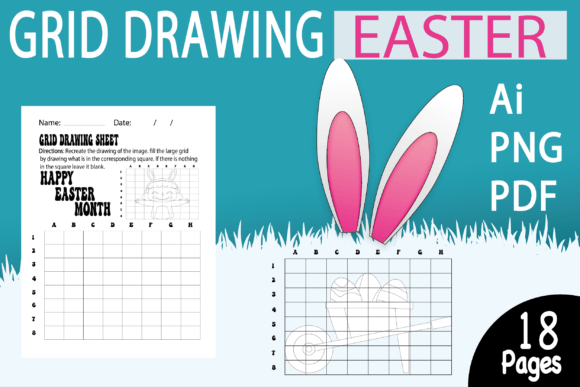
Practicality shapes how people evaluate a resource, so knowing exactly what you get matters. The ZIP file contains a PDF with 18 printable pages, all sized at 8.5 x 11 inches — standard letter size for hassle‑free printing anywhere. Each page guides students through drawing a different Easter‑themed image using a simple coordinate grid. The x‑axis is clearly marked with letters, the y‑axis with numbers, and a key or partially completed grid often helps beginners get started. The pages vary so that a teacher can pick a single design for the whole class or let students choose their favorite. No additional software or special editing is required; just unzip, open, and print.
For a classroom teacher with a tight photocopy budget, the black‑and‑white format is ideal. It copies cleanly and doesn’t drain color ink. For a parent at home, having 18 distinct pages means the activity doesn’t get stale over the Easter break — one child can complete multiple drawings without repeating the same picture. Because it’s all in one PDF, you can print the whole pack in one click or select only the pages you want through your printer dialogue.
Seasonal Display and Celebration Ideas
Easter often brings spring assemblies, egg hunts, and classroom parties, and the finished grid drawings fit into each. Pinned onto a cork strip, they create a collaborative mural that students can point to proudly. If you’re an educator who sends home a holiday folder, slipping in a completed grid drawing adds a personal touch that parents treasure far more than a generic worksheet. Some teachers have even used the drawings as covers for student‑made Easter cards or as part of a larger tabletop display during a spring open house.
Themed days rarely need to sacrifice academic content, and this activity proves it. While children think they’re simply making a bunny appear, they’re practicing letter‑number coordination, fine motor control, and sequencing. A quick‑fire oral practice — “Who can find E‑3 the fastest?” — turns the worksheet into a game before drawing even begins. As Easter approaches and attention spans shorten, having a task that feels festive yet requires real focus becomes an invaluable classroom management tool for educators, and a sanity‑saver for parents at home.
Whether you adopt the Easter Day Grid Drawing Worksheet for Primary Middle Grades for its math connections, its artistic heritage, or simply the joy of a holiday project, the resource meets a wide spectrum of needs with surprising depth. The combination of a gentle coordinate introduction, a time‑tested drawing method, and the seasonal motif makes it a toolkit piece you’re likely to pull out each spring — and one that different users, from first‑year teachers to experienced homeschoolers to weekend doodlers, will each value in their own distinct way.